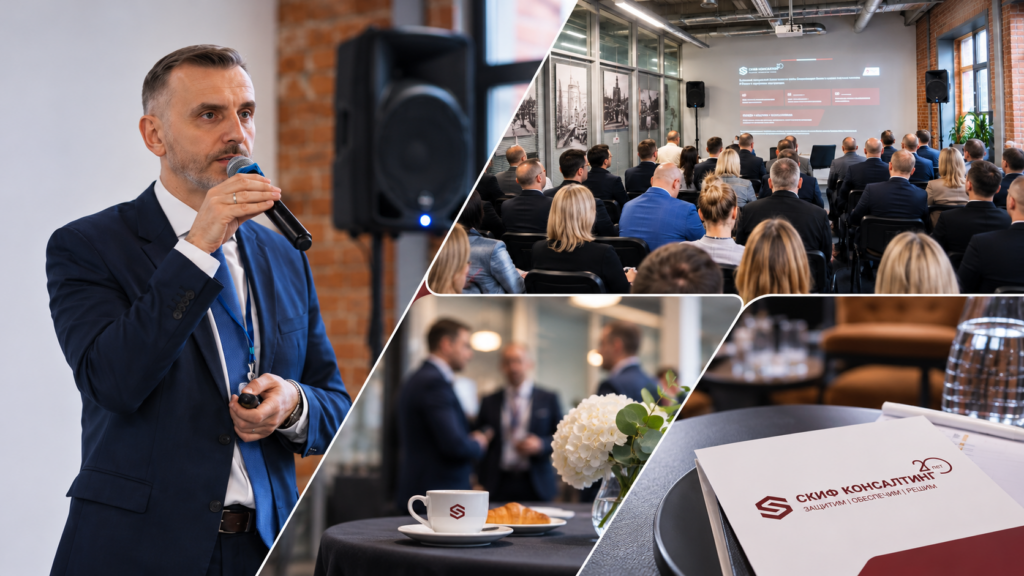
What matters today for international businesses operating in or with Russia. Business breakfast, October 14
On 14 October, Skif Consulting, together with the Center for Eurasian Cooperation and Teamship, held a business breakfast dedicated to the current environment for international companies operating in and with Russia. The discussion covered economics, geopolitics, HR and law.
The legal environment for international business
Dmitry Demidenko, Managing Partner of Skif Consulting, spoke about the changing legal landscape and its practical impact on international companies.
Today, it is no longer enough to determine whether a particular structure is formally permitted. Before entering into a transaction, businesses need to assess whether the payment can actually be made, control over the asset can be maintained, the agreement can be performed and the expected economic result can ultimately be achieved.
Key topics discussed
The discussion covered special approval regimes and temporary management, cross-border payments and banking compliance, sanctions restrictions, dispute resolution, personal data and IT, as well as current practice relating to transactions and payments involving a foreign element.
Particular attention was paid to payment routes. In the current environment, they should be planned before an agreement is signed: a transaction that is legally permissible on paper may prove unworkable if banking and regulatory restrictions have not been considered in advance.
The participants also discussed international dispute resolution and why an arbitration clause alone no longer always guarantees that a dispute will follow the originally intended scenario.
The legal function needs to stay one step ahead
The main practical takeaway from the meeting is that, in a rapidly changing regulatory environment, the legal function needs to be proactive.
Risks should be identified before a transaction, enforceability should be tested before documents are signed, and the expected result should be assessed not only from the perspective of “is it legal?” but also “will it actually work?”
We thank our colleagues, speakers and participants for the substantive discussion. Meetings like this are particularly valuable because they allow legal theory to be compared with the challenges international businesses face in practice every day.